FAQ
dnl & AI disclosure software
What is dnl?
dnl is AI disclosure management software for external auditors. The platform helps audit teams review disclosures, validate financial statement figures, link audit documentation and manage structured audit workflows — with human oversight at every step. dnl is built around two core modules: ai/checklist for automated disclosure checklists, and ai/numbers for financial statement tie out and consistency checks. The company is dnl Deep Neuron Lab GmbH, based in Berlin and used by 15,000 auditors globally.
What is AI disclosure management software?
AI disclosure management software helps audit teams review financial statement disclosures, management reports and sustainability reports against the applicable requirements. It combines structured checklist logic, source-document review, AI-generated suggestions, audit documentation and version control inside one workflow — with the auditor approving every conclusion. dnl is purpose-built for external auditors, with ai/checklist handling disclosure checklist automation and ai/numbers handling financial statement tie out and consistency checks.
Who is dnl built for?
dnl is built for external audit firms — the engagement teams and reviewers, partners and innovation leads who deliver disclosure-heavy audits. Whether the engagement is financial audit, ESG audit or limited assurance, dnl supports teams that need to reduce manual disclosure work while preserving audit quality, traceability and professional judgment. The platform is used by audit firms ranging from independent practices through to global networks.
What problem does dnl solve for audit firms?
dnl reduces repetitive manual work in disclosure review, checklist completion, financial statement validation and version comparison. Audit teams typically spend hours searching across PDFs, Excel files and supporting documents to validate disclosures and tie out figures. dnl automates the search-and-validate work so engagement teams spend their time on exception review, judgment areas and client-specific risk — not data hunting.
Which audit workflows does dnl support?
dnl supports disclosure review, audit checklist automation, financial statement tie out, mathematical and internal consistency checks, prior year disclosure comparison, document version control, ESG and ESRS disclosure review, and management report review. The platform works across financial audit and ESG audit engagements with a shared workflow structure — engagement teams that already use dnl for financial audits can extend the same workflow into sustainability assurance without learning a new system.
How is dnl different from other audit software?
dnl is purpose-built for external auditors and the disclosure-review workflow. Most audit software started as working-papers or audit-management tools and added AI later; dnl was AI-native from day one, trained on audit data, built around the disclosure-review process and bound by audit-grade controls. Methodology-aware (your checklist, your firm), end-to-end across the disclosure-audit lifecycle, and aligned with the EU AI Act, ISO 27001 and GDPR — not retrofitted, not generic.
Is dnl suitable for audit firms of different sizes?
Yes. dnl is used by small and mid-tier firms as well as global networks. The platform adapts to each firm’s checklist methodology, engagement scope and review structure — not the other way around. Smaller firms benefit from the checklist standardization and review automation; larger firms benefit from the cross-engagement consistency and audit-grade governance. dnl supports both plug-and-play SaaS adoption and white-labelled deployments depending on the firm’s implementation needs.
ai/checklist
What is ai/checklist?
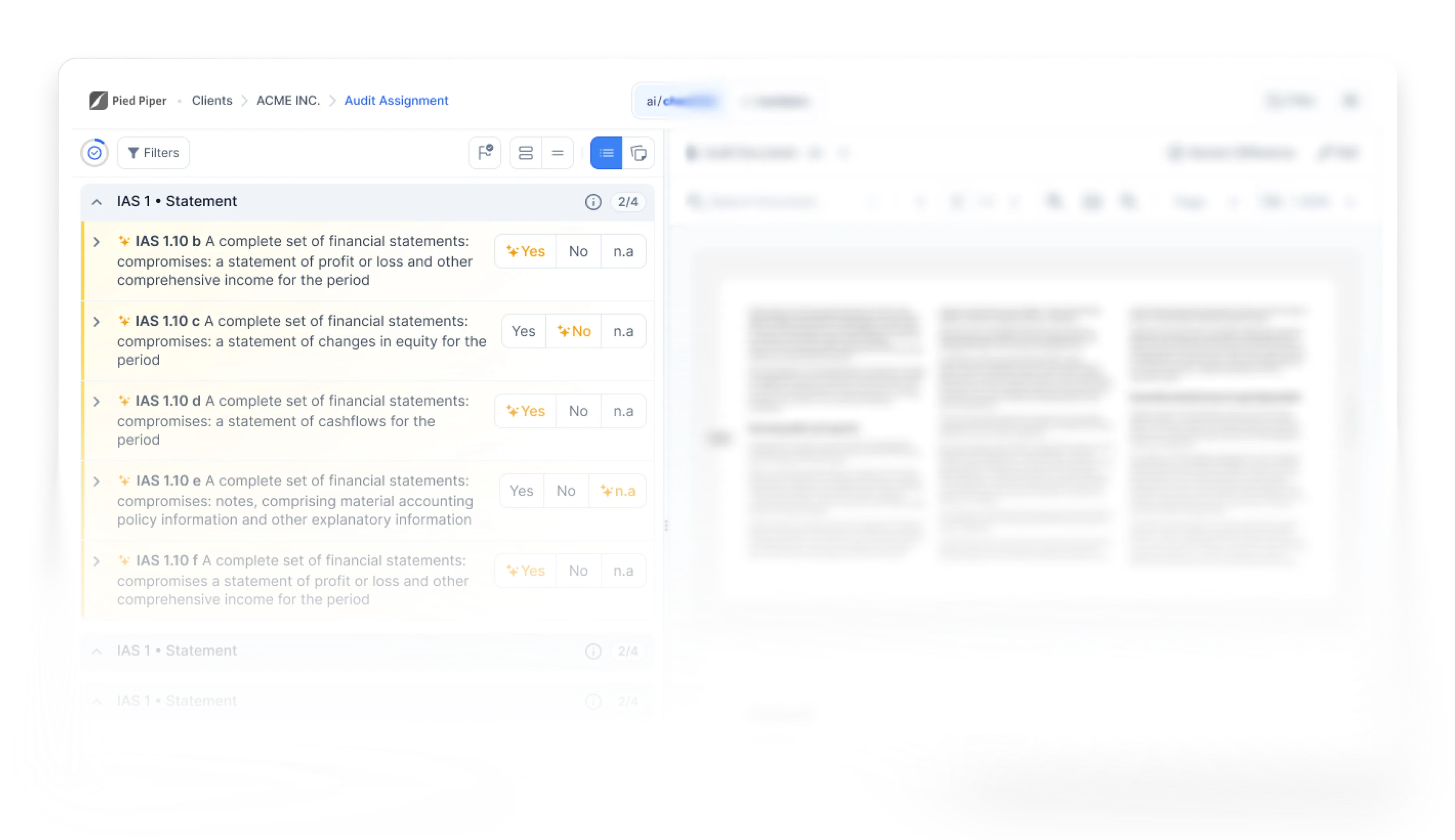
ai/checklist is dnl’s automated disclosure checklist module. It walks audit teams through every disclosure requirement step-by-step, suggests checklist answers based on the source documents, flags missing or inconsistent disclosures and documents review decisions in an audit-grade trail. The platform supports firm-specific checklist methodologies — your team’s checklist logic, your reviewer patterns, your engagement standards. Auditors review every suggestion before it’s accepted.
How does ai/checklist support disclosure review?
ai/checklist connects each disclosure checklist question to the relevant passages in the financial statements, management report or sustainability disclosures. It identifies whether a disclosure requirement appears met, missing, inconsistent or not applicable — and proposes a checklist answer with source references. Auditors review the proposed answer, validate the references, and confirm or adjust the response. The result is a structured, traceable disclosure review with the audit trail built in.
Does ai/checklist support IFRS disclosure checklists?
Yes. ai/checklist supports IFRS disclosure checklists today, adapted to your firm’s specific IFRS methodology and engagement scope. US GAAP (FASB ASC) disclosure checklists are supported as well, so teams working across both frameworks run them in the same workflow. ai/checklist is also used for ESG disclosure review under ESRS, ISSB and GRI frameworks.
Can ai/checklist support firm-specific audit methodologies?
Yes. ai/checklist is configured around the audit firm’s methodology — your checklist structure, your review patterns, your engagement standards. The system doesn’t impose a generic checklist on your team. In year one, ai/checklist learns your firm’s patterns; by year two, it reflects how your firm makes calls, which references your reviewers care about and where your engagement teams typically flag exceptions. The methodology stays with the firm.
How does ai/checklist support roll-forward workflows?
ai/checklist supports roll-forward workflows by reusing the prior-year checklist structure, identifying which disclosures have changed in the current year, and focusing review attention on the updated content. Items that are unchanged year-over-year carry forward with their prior-year evidence and reviewer rationale intact. Items that have changed get reopened automatically — so the engagement team’s effort goes to the real differences, not re-validating last year’s work.
Can ai/checklist suggest audit procedures and validations?
Yes. ai/checklist suggests relevant procedures and validations based on the content and structure of the audit engagement — the financial statements, the supporting documents, prior-year context and the applicable framework. Each suggestion comes with the source references it’s based on. Auditors review the suggestion, validate it, and decide how to proceed. The system supports the workflow; the procedure decision stays with the auditor.
How do auditors stay in control when using ai/checklist?
Auditors stay in control by reviewing every AI-generated suggestion before it’s accepted. ai/checklist proposes an answer and the supporting source references — the auditor validates the references, resolves exceptions and makes the final disclosure review decision. The system supports the workflow; the professional judgment stays with the auditor. Every accepted response is recorded in the audit trail with the AI suggestion, the source references and the reviewer’s confirmation.
ai/numbers & ai/compare
What is ai/numbers?
ai/numbers is dnl’s module for financial statement tie out, mathematical consistency validation and prior year disclosure comparison. It identifies figures across financial statements, notes, tables and supporting documents, maps them to their references, and flags any inconsistency for auditor review. ai/numbers handles internal consistency, external validation against supporting documents and prior-year comparison — automating the tick-and-tie work auditors typically do manually.
How does ai/numbers support financial statement tie out?
ai/numbers automates tick-and-tie by identifying figures across the financial statements, notes, tables and supporting documents, then checking that every figure is consistent across each location it appears. It flags any discrepancy — a number that doesn’t match between the income statement and the supporting note, a total that doesn’t add up, a prior-year figure that’s changed — for auditor review. What’s typically hours of manual cross-checking becomes minutes of exception review.
Can ai/numbers handle prior year disclosure comparison?
Yes. ai/numbers automatically compares current-year figures and disclosures against the prior-year report, flagging changed values, unusual movements, missing updates and roll-forward issues. The system surfaces what’s changed so auditors can focus on whether the change is reasonable, properly disclosed and appropriately supported — instead of manually re-reading every page of last year’s financial statements to find the differences.
Does ai/numbers process Excel and PDF files?
Yes. ai/numbers processes both structured and unstructured formats, including Excel files, PDFs and report tables. It identifies figures consistently across formats — the same number in an Excel schedule, in a PDF disclosure note and in a supporting invoice gets mapped together. This is critical for tie-out work, where supporting documents almost always arrive in different formats than the financial statements themselves.
How does ai/numbers support disclosure consistency checks?
ai/numbers runs four kinds of disclosure consistency checks: mathematical (do the totals add up?), internal (is the same figure consistent across all places it appears in the report?), external (does the figure match the supporting documentation?), and prior-year (how has it changed?). Each check runs automatically across the full document set, and any discrepancy is surfaced for auditor review with the source references attached.
What is ai/compare and how does it work with ai/numbers?
ai/compare is dnl’s document comparison module. It identifies changes between document versions so audit teams can focus on what changed rather than re-reading entire reports. When a client provides an updated financial statement or sustainability report, ai/compare highlights the differences, ai/numbers re-validates the affected figures, and ai/checklist re-opens the disclosure checklist items that the changes touch. Version control and change tracking are built in.
Does ai/numbers only work on financial statements?
No. ai/numbers supports financial statement review, regulatory reporting validation, M&A due diligence, internal control assessments and any audit workflow where figures need to be validated against supporting documentation. The underlying engine — identifying figures, mapping them across formats, checking consistency — is the same regardless of the document type. The use case is broader than the financial-audit workflow it’s best known for.
Documentation, traceability & version control
How does dnl support audit documentation?
dnl builds the audit documentation as a by-product of the review work, not as a separate task at sign-off. ai/checklist records every checklist response with the AI suggestion, the source reference and the reviewer’s confirmation. ai/numbers records every validated figure with the documents it was traced to. The documentation is complete when the engagement closes — and it’s structured for peer review, partner sign-off and regulator request without rework.
How does dnl create an audit trail?
dnl records every AI-supported suggestion, source reference, reviewer modification and document change as the engagement progresses. The audit trail is created as the work happens — not reconstructed at sign-off. Reviewers and partners can trace any audit conclusion back through the chain: AI suggestion → source reference → reviewer decision → final accepted response. When a regulator or peer reviewer asks how a conclusion was reached, the answer is one click away.
How does dnl handle updated client documents?
dnl supports version control and change tracking through ai/compare. When a client provides an updated financial statement, sustainability report or supporting document, dnl identifies the changes, highlights the affected disclosures, and reopens the relevant checklist items and figure validations for re-review. Engagement teams don’t manually hunt for what’s different — the system surfaces it and routes the work back through the appropriate review steps.
Why is version control important in disclosure review?
Client documents change mid-engagement — financial statements get revised, management reports get updated, sustainability disclosures get adjusted. Without explicit version control, changed disclosures can be missed or accepted without proper re-review. A controlled version history lets audit teams identify which disclosures changed, reopen the relevant review steps, document why updated information was accepted, and demonstrate the chain of review at sign-off.
How does AI improve consistency in disclosure review?
AI improves consistency by applying the same checklist logic, the same source-linking rules and the same documentation standard across every engagement. Different teams reviewing different clients still produce comparable, peer-reviewable disclosure files. ai/checklist learns your firm’s checklist patterns over time — by year two, the system reflects the way your firm makes calls, not a generic baseline. Deviations get flagged automatically.
How does AI support disclosure review in daily audit work?
AI structures the disclosure review workflow so auditors stop spending time searching across PDFs, Excel files and reports for the right reference. ai/checklist walks through every disclosure requirement, proposes a checklist response with source references, and lets the auditor confirm, adjust or reject. Daily audit work shifts from “find the right paragraph” to “review the proposed answer and decide” — more judgment, less hunting.
ESG, ESRS & sustainability
What is an ESG audit?
An ESG audit validates sustainability disclosures against the applicable framework — ESRS for CSRD reporting in the EU, ISSB (IFRS S1 and S2) for global sustainability standards, or GRI for broader sustainability reporting. The audit covers environmental, social and governance information and checks consistency, completeness and traceability to source evidence. Most ESG audits today are limited assurance rather than reasonable assurance, with the scope and procedures defined by the engagement and the applicable standard.
Can dnl support ESRS and CSRD limited assurance?
Yes. dnl supports ESRS and CSRD-related limited assurance through ai/checklist’s disclosure checklist automation and ai/numbers’ figure validation. ai/checklist guides auditors through ESRS disclosure requirements, maps source content from the sustainability report to checklist questions, and documents review decisions. ai/numbers handles the quantitative side — sustainability data points, percentages, totals and prior-year comparisons. The audit trail is structured to support limited-assurance review and audit-grade documentation.
How does AI handle qualitative ESG disclosures?
AI handles qualitative ESG disclosures by identifying the relevant statements in the sustainability report, suggesting checklist responses with the underlying source references, and highlighting missing or inconsistent disclosures. The auditor remains responsible for evaluating the substance of the disclosure — whether the narrative is materially complete, whether the framing is fair, whether the supporting documentation is sufficient. AI accelerates the identification and structuring; the assurance judgment stays with the auditor.
Which sustainability standards can dnl support?
dnl supports the major sustainability frameworks: ESRS for CSRD reporting in the EU, ISSB (IFRS S1 and IFRS S2) for global sustainability standards, and GRI for broader sustainability disclosures. The exact configuration depends on the firm’s methodology, the engagement scope and the applicable standards in the reporting jurisdiction. ai/checklist’s checklist structure adapts to the framework being audited, so the same workflow handles different sustainability assurance engagements.
How does dnl support both financial audit and ESG audit teams?
dnl uses the same workflow structure for financial audit and ESG audit because the underlying activities — disclosure review, checklist validation, source linking, documentation — are the same. ai/checklist handles ESG disclosure requirements alongside financial disclosure requirements. ai/numbers handles sustainability data points alongside financial figures. Engagement teams that already use dnl for financial audits extend the same workflow into ESG audits without learning a separate system or platform.
Can ESG audits be integrated into existing audit workflows?
Yes. ESG audits integrate cleanly into existing audit workflows because the underlying structure — disclosure review, checklist validation, source linking, documentation — is the same. ai/checklist handles ESG disclosure requirements alongside financial disclosure requirements. ai/numbers handles sustainability data points alongside financial figures. Engagement teams that already use dnl for financial audits extend the same workflow into ESG audits without learning a separate system.
Human oversight, AI governance & security
Does dnl replace auditors?
No. dnl supports auditors but does not replace them. AI-generated suggestions are advisory — auditors remain responsible for reviewing outputs, validating source references, resolving exceptions and making final audit decisions. Human-in-the-loop is built into the architecture, not bolted on as a feature. Every accepted response is recorded with the AI suggestion, the source reference and the auditor’s confirmation, so the chain of review is always visible.
How does dnl support responsible AI use in audit?
dnl supports responsible AI use through transparency, source references, human review, audit trails and documented limitations. Every AI-supported result is traceable to its source documents. Every conclusion is reviewed by an auditor. The platform’s controls align with the EU AI Act’s risk-based standards for AI in regulated industries, with ISO 27001 certification for information security and GDPR compliance for data handling. The system supports — never replaces — human decision-making.
Are AI-generated answers traceable in dnl?
Yes. dnl is designed for traceability. AI-supported suggestions, source references, source links, document changes and human modifications are all recorded so reviewers, partners and regulators can understand how an answer was created, validated and accepted. The traceability isn’t an add-on; it’s the architecture. If an answer needs to be defended in a peer review or regulator inspection, the chain is structured for that purpose.
Is dnl secure enough for audit firms?
Yes. dnl uses enterprise-grade encryption, role-based access controls, single sign-on, regular penetration testing and continuous monitoring. The platform is ISO 27001 certified and GDPR compliant. Client data is hosted in the firm’s region — EU, US or Australia — with the appropriate data-residency controls. Information security is core to the platform’s design, not retrofitted.
How does dnl align with the EU AI Act, ISO 27001 and GDPR?
dnl is ISO 27001 certified for information security management, GDPR compliant for data handling and aligned with the EU AI Act’s risk-based standards for AI in regulated industries. Audit work falls under the EU AI Act’s higher-risk categories, so the platform’s controls — traceability, human oversight, documentation of model behavior, source-referenced outputs — are designed to support audit firms operating under the Act’s requirements.
How does AI support disclosure quality review?
AI supports disclosure quality review by applying consistent checklist logic across every engagement, surfacing exceptions earlier in the review cycle and standardizing how disclosure review decisions are documented. Partners reviewing engagements see the same checklist structure, the same source linkage and the same audit trail format across files — making quality review faster and more reliable. Exceptions that previously surfaced at sign-off get caught at fieldwork stage.
Can AI reduce repetitive disclosure review tasks?
Yes. ai/checklist auto-populates a high proportion of disclosure checklist responses based on the source documents, and ai/numbers ties out thousands of figures in seconds. The repetitive cross-checking, document searching and reference matching that previously consumed engagement hours becomes minutes of exception review. Auditors don’t disappear — their attention shifts to the items the AI flagged as missing, inconsistent or judgment-dependent.
Implementation & buying
How can an audit firm start with dnl?
Most audit firms start with a focused pilot — a small team, a defined engagement scope, a single audit cycle. The pilot proves out methodology fit, time savings and reviewer acceptance before broader rollout. Implementation and customer success teams support the pilot end-to-end. By the second engagement, the AI has learned the firm’s checklist patterns and the time savings become measurable. By the third engagement, the workflow is normalized.
Which audit workflows should firms automate first?
Audit firms typically start with the most repetitive, high-volume and review-heavy workflows: disclosure checklist completion, financial statement tick-and-tie, prior year disclosure comparison and ESG disclosure review. These are the workflows where AI-supported automation delivers measurable time savings quickly, and where the documentation trail is straightforward to demonstrate to peer reviewers. Judgment-heavy workflows come later, once trust in the platform is established.
Can dnl fit into existing audit methodologies?
Yes. dnl is designed to fit into existing audit methodologies rather than replace them. Audit firms configure ai/checklist around their own checklist structures and review procedures, with the platform learning firm-specific patterns over time. Audit results export to PDF, Excel, Word or via API into existing audit management systems. dnl runs alongside firm methodology — it doesn’t impose a new one.
Does dnl offer a white-labelled solution?
Yes. dnl supports both plug-and-play SaaS adoption and white-labelled deployments depending on the audit firm’s strategy, methodology and implementation needs. White-labelling lets firms present the platform under their own brand inside client-facing engagement workflows, while still benefiting from the underlying AI capabilities and audit-grade controls. Implementation teams support both deployment models.
Do auditors need technical skills to use dnl?
No. dnl is built for audit workflows, not for data scientists. Auditors work with structured checklists, document references and proposed validations — there’s no prompt-writing, model configuration or technical pipeline to manage. The skills you already have as an auditor are the skills the system is designed around. AI handles the cross-referencing, evidence linking and consistency checking under the hood.
How can audit firms scale disclosure review with dnl?
AI disclosure management software lets audit firms handle more engagements without proportional increases in senior headcount. dnl standardizes checklist logic, automates tie-out and prior-year comparison, and documents review decisions in a consistent format — so a firm can scale engagement volume while keeping quality consistent across teams. Partners get back the review hours they currently spend on rote validation work, and senior staff time goes to judgment-heavy areas.
How can partners protect audit firm margins with dnl?
AI disclosure management software protects audit firm margins by automating the rote disclosure-review and tick-and-tie work that typically consumes the most engagement hours. Senior auditors spend less time validating numbers and more time on judgment-heavy review. Audit firm partners spend less time fixing missed disclosures at sign-off. Firms can deliver deeper analysis at the same fee, defending pricing against margin pressure while improving review quality.
How does dnl support audit firm transformation with AI?
dnl supports audit firm transformation through proven pilot-to-scale programs, multi-jurisdiction compliance (EU AI Act, ISO 27001, GDPR) and direct partnership across the rollout. Innovation and transformation leads get measurable ROI metrics to defend the investment internally, plus methodology flexibility that respects each engagement team’s existing way of working. dnl evolves with your firm — adoption-by-imposition isn’t the approach.
What are the key challenges when introducing AI in disclosure review?
The main challenges are trust, methodology fit and change management. Trust is addressed by source-referenced suggestions every reviewer can validate. Methodology fit is addressed by configuring dnl around the firm’s existing checklist structure rather than imposing a generic one. Change management is addressed through structured pilot programs that let the team see results on their own engagements before broader rollout. The technical AI piece is the easy part; the audit-process piece is where careful implementation matters.
How does dnl scale across an audit practice?
dnl scales across an audit practice through firm-wide methodology configuration — once the checklist structure and review patterns are set up, every engagement team in the practice gets the same standardized workflow. Multi-jurisdiction compliance is built in. Audit-grade governance is consistent across engagements. Innovation leads can deploy globally on a single platform without rebuilding the methodology for each jurisdiction.
Ready to Transform Your Audit Process?
Contact us today for a personalized demo and discover how ai/checklist & ai/numbers can elevate your audit capabilities.