The case against AI replacing auditors
· Andreas Schindler, CEO | dnl.ai

We all know the prevailing story. That is, artificial intelligence (AI) is going to replace workers, handle both the drudgery and the important tasks in our work. To many, the question isn’t “if” AI will take over, it’s “when.”
Our experience in the auditing industry is that the narrative of AI replacement theory is flawed. As machines take on more of the evidence-gathering, the human decision about what that evidence proves becomes the most valuable, and most exposed, act in the audit.
It’s an assessment that comes not only from our experience building AI audit software but from research, our own product data, and the regulatory record. To the layman, audits may seem to be an area in which full automation can create efficiency and eliminate error: the fewer humans, the better. For audit practitioners, even those implementing AI models into audit systems, the reality is the opposite: human auditors become more essential, not less.
That’s because an audit is not a productivity product. An audit gives assurance. Investors, lenders, and regulators use that assurance when they make critical decisions about capital. A tool like AI can make an audit faster. But if the tool makes the conclusions more difficult to defend, the tool does not improve the audit, it just moves the risk to a place more difficult to find.
All of this may sound like a case against AI in audit, but it’s not. AI is already in audit for good reason. AI audit tooling, designed to know its limits, combined with experienced human audit judgment produces work that is better on the measure that matters: the evidence behind the conclusions is more complete, and easier to defend on inspection.
In this article we examine how labor data reveals (despite the fears) that AI in most cases does not replace human work and responsibility, especially in audit functions. We explain how history shows that bad audit evidence is a human failure, not a technical one, and why that’s not going to change. Finally, we discuss why regulatory approaches suggest that while rules may be different across regions, principles that put human judgment and accountability above technology are converging across standards-setting bodies.
Labor data: judgment is still (and will be) human
AI and its effect on labor is one of the most studied issues of the last few years. Though forecasts are still changing, clear, data-backed trends have emerged.
- PwC examined more than 1 billion job advertisements in 27 countries for the 2026 Global AI Jobs Barometer. It found entry-level roles with AI exposure are seven times more likely to need judgment and leadership, or “senior skills.” Postings for senior skills roles rose 35 percent from 2019. Roles that didn’t require leadership or judgment declined 10 percent.1
- The study divides the market into two groups: “professionalized” roles, in which AI increases the value of expert judgment, and “democratized” roles like coding, in which AI makes the work possible for non-experts. Professionalized roles are growing twice as fast. PwC does not classify audit in the report. That placement is ours. We put audit in the first group because its output is a signed opinion a named person is liable for, which is not work that gets handed to non-experts.
- PwC found that at the companies with the most AI exposure, headcount increased by 52 percent. At the companies with the least AI exposure, headcount increased by 36 percent.
- An analysis released in August by the New York Federal Reserve points the same way, at least so far: firms report that AI is changing the skills they hire for far more than it is eliminating jobs, though the same firms expect AI-driven reductions to rise.2 The Budget Lab at Yale found the occupational mix shifting no faster than it did when the PC and the internet arrived.3
It’s that comparison, the PC or the typewriter, that’s appropriate to the audit industry. Neither changed the responsibility for what was created with the tool. A letter was still a letter. The content was still the product of the writer. Both were bridges that helped improve the final product: readable text, grammar and spelling checked and corrected, easily distributed formats.
The failure mode of audit is older than technology
The historical lesson of auditing is clear. While technology may contribute to audit failure, it is never responsible. Human auditors and management are.
One of the most instructive examples is from our own backyard. Founded in 1999, Germany-based payment processor Wirecard achieved what seemed to be rapid growth during the next two decades. In 2018, the company was included in the DAX, Germany’s biggest stock benchmark. Two years later, Wirecard filed for insolvency after a massive fraud built on falsified documents, including electronic screenshots.
From 2016 to 2018, Wirecard’s auditor used documents and screenshots to verify the company’s cash held abroad, rather than asking the banks themselves. By the 2019 accounts, the balance in question had reached about €1.9 billion, said to sit in trustee accounts at two banks in the Philippines. Both Wirecard and a third-party trustee supplied documents. The auditor did not ask the banks directly.
The auditor’s decision to lean on evidence submitted through the client’s own channels introduced risk. In audit, the chain is more important than each document, and the Wirecard chain kept adding links. A trustee held the accounts. The banks had no direct relation with Wirecard. Each link in the chain decreased what the auditor could verify. The confirmations for the trustee came through the same channel that stated the balances. In other words, every link in the chain ran through the company being audited, so the evidence only confirmed itself.
In 2020, the auditor made direct contact with the two banks. The banks said that the documents with their letterheads were false. The confirmation fraud succeeded because no one controlled the chain the confirmations traveled through. Wirecard became insolvent some days later.
A senior auditor at a competitor said that direct confirmation of bank balances is first-year training. ISA 505 says that the auditor must control the external confirmation process. A screenshot from the client is not a confirmation. It is the assertion of management, used as evidence for the assertion of management.
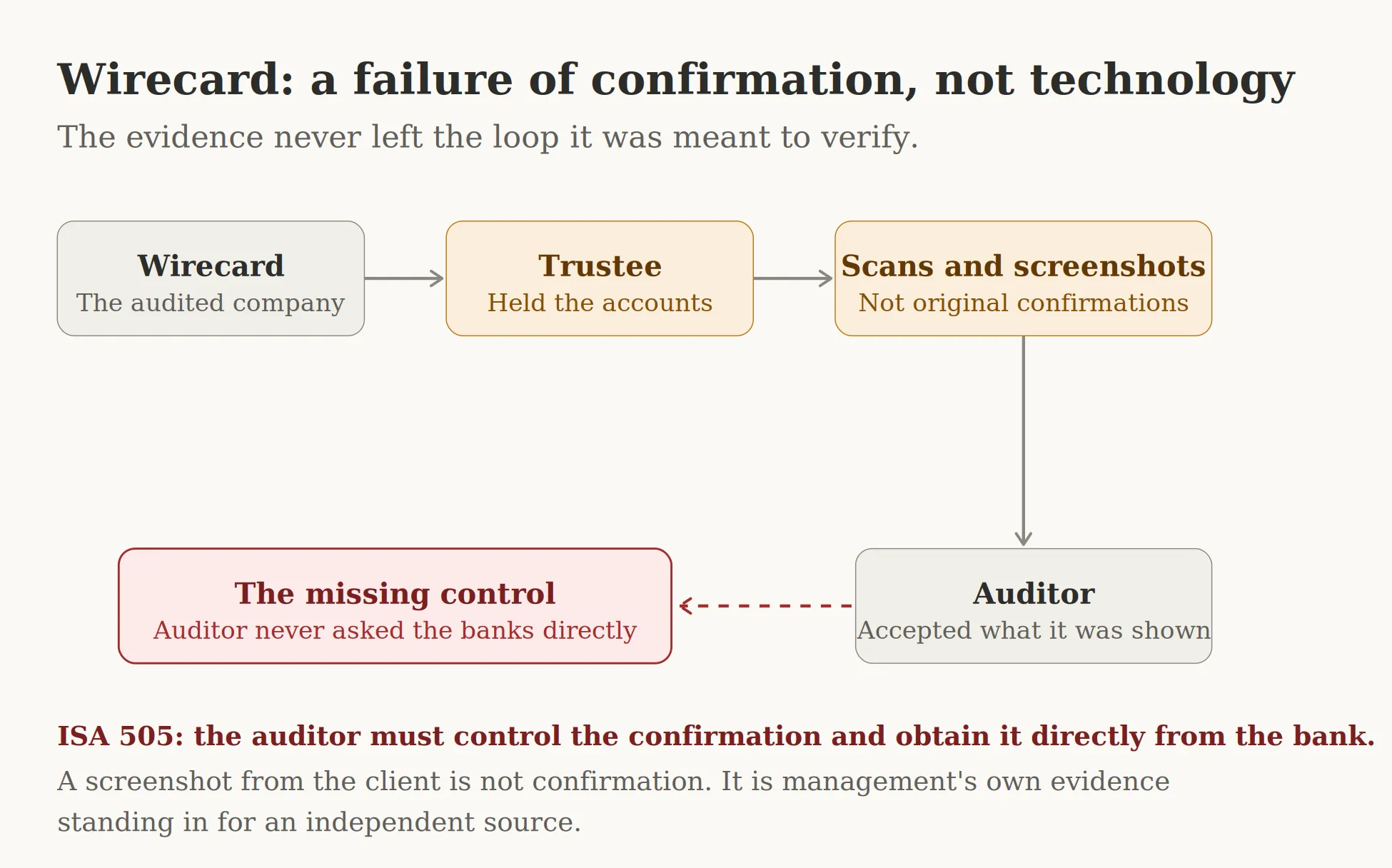
Germany’s audit oversight authority, APAS, found that Wirecard’s auditor (not the PC that made the screenshots) had breached its professional duties. The auditor was fined €500,000 and barred from taking on new public-interest clients in the country for two years.4 The findings underscore the point: Frauds will always be attempted, but audit failure is a failure of human judgment, in this case, a decision to accept management’s own evidence in place of independent confirmation.
To take this idea one step further, the shortcuts Wirecard’s audit team accepted were efficient, but massively flawed. Skipping confirmation saved time and steps on every audit that used those documents. It didn’t matter, because none of it was real. AI can make audits fast. Whether they are true still depends on evidence that does not confirm itself.
More capable tools raise the judgment load, not lower it
AI audit tooling is often pitched as faster and more efficient. The best of it delivers higher quality: it can pre-populate answers, direct review effort to the uncertain items, and point auditors straight to the source. The auditor still reviews, approves, and signs.
AI audit tools work best when they set up the human auditor for decision-making, not replacing judgment. Research on automation bias shows that people give too much weight to automated recommendations. These people do less independent verification. They accept the errors of the system. The effect is stronger when there is time pressure and when the risk is high.5
The bias increases when a machine does part of the judgment: the auditor sees less of the logic and depends more on the output of the machine. A commentary published by the ICAEW made the same point to practitioners: an auditor can shift from active analysis of data to passive review of an analysis a machine made, depending on how the system is designed.6 In other words, an opaque auditing or accounting AI system makes practitioners more dependent on the automation.
An AI audit system built around calibration (i.e., one that quantifies its own uncertainty and routes low-confidence items to human review) rather than maximum autonomy is the better model. Put another way, it’s a system that knows what it doesn’t know. A system that sends questions or work to a person may seem “inefficient” to some. But a tool that answers all questions with confidence moves risk to the reviewer. A tool that stops when it is not sure puts human attention where judgment is necessary.
We can put numbers on this from ai/checklist. In the first months of 2026, it worked through 1.69 million disclosure-checklist questions under German GAAP, Austrian GAAP, IFRS, and ESRS. On the questions it was confident enough to answer by itself, reviewers accepted 98.17 percent of the answers without correction; human-prepared answers in the same process were accepted 92.68 percent of the time. The metric is reviewer acceptance, and the auto-answered questions are by design the ones the system judged it could handle, so the harder ones went to people. That routing is the calibration working, and any firm can test the figures on its own engagements.
Anyone who has used a general AI platform knows the experience. You prompt a question and the AI provides a confident answer that could be entirely wrong or made up. For an individual who catches the mistake, it’s just frustrating. If they don’t catch the mistake, all work stemming from the original answer is flawed. In audit, that flaw can be fatal, and human review becomes critical. A tool built for audit needs to be different. It needs to stop when it isn’t sure and bring the issue to the attention of a human auditor.
Ultimately, it isn’t that the machine answers more; it’s that it knows what answers it can stand behind, and which belong to human review and says so. That judgment, not the speed, is what keeps the audit defensible.
Different rules, but aligned principles
Human accountability has led the approach to audit standards for as long as they have existed. The rise of AI, however capable the tooling, should not shift that responsibility to technology.
It’s not hard to see how overly prescriptive standards could misfire. A regulator could appear responsible in mandating model documentation, fixed valuation thresholds, or specific testing procedures. But rules written at that level of detail risk being overtaken before they take effect, and a firm that uses a better model would be exposed to “noncompliance” while audit quality is suppressed. That is an argument about sequencing, not against rules: guidance can come first and inform the eventual standard.
A standards-setting process built around principles is the more nimble and effective approach, especially in a realm where technology moves faster than standards-setting bodies. As we outlined in our comment on the PCAOB’s request for public comment (Release No. 2026-005, filed August 7), rule-making bodies are taking different paths, but converging on aligned principles.
- In the UK, the FRC has taken a leading stance on AI guidance, including generative and agentic AI guidance issued in March 2026.
- The WPK in Germany keeps an updated AI FAQ catalog.
- The IAASB published proposed revisions to its evidence standards in August and opened a comment period. The PCAOB has, for the first time, opened its standard-setting agenda itself to public comment. (We asked the Board for staff guidance now, ahead of a full standard-setting cycle.)
And the principles they should converge on are:
- Traceability. Every AI-assisted conclusion can be traced back to the specific evidence on which it rests.
- Reproducibility. The inputs, model versions, configurations, and outputs are documented in enough detail that a reviewer can re-perform and evaluate the procedure, because re-performance is what an inspection depends on.
- Human accountability. A documented record shows a human auditor reviewed the work and remains responsible for the conclusion. The tool proposes; the auditor decides and signs.
In our view, the choice is not between the human auditor and the machine. It is between audit that is merely faster and one that is genuinely better. For investors, there is only one choice: traceable, reproducible, human-accountable results. AI audit tooling designed to know its own limits, clearing the routine and handing the judgment calls back to human review, puts the auditor’s attention where it belongs.
The firms getting this right are building and incorporating systems that enhance and focus human judgment. The question they ask of the technology is not how many hours it saves, but whether the resulting file is easier to defend on inspection. Together, the result is better audits.
Footnotes
-
PwC, 2026 Global AI Jobs Barometer, 15 June 2026. ↩
-
Federal Reserve Bank of New York, “AI’s Impact on Labor and Hiring”, Liberty Street Economics, August 2026. ↩
-
The Budget Lab at Yale, “Evaluating the Impact of AI on the Labor Market: Current State of Affairs”. ↩
-
Abschlussprüferaufsichtsstelle (APAS), Germany’s auditor oversight body, decision announced 3 April 2023 concerning EY (Ernst & Young GmbH). APAS found breaches of professional duty in the Wirecard audits for 2016 to 2018, imposed a €500,000 fine on the firm and a two-year ban on accepting new public-interest audit mandates in Germany, and fined five individual auditors between €23,000 and €300,000. EY dropped its appeal in 2024, and the ban expired in March 2026. Reported by CNN, Bloomberg, and the Financial Times. ↩
-
Raja Parasuraman and Dietrich Manzey, “Complacency and Bias in Human Use of Automation: An Attentional Integration,” Human Factors 52(3), 2010, 381–410; Linda Skitka, Kathleen Mosier and Mark Burdick, “Does automation bias decision-making?”, International Journal of Human-Computer Studies 51(5), 1999, 991–1006. ↩
-
ICAEW, “Over-reliance on automation: a cautionary tale from Plato”, May 2024. ↩